My son and I went to the museum today; we went to the Norton Art Gallery. The last time I was there was exactly a year ago. I wish I could say we went because John wanted culture and refinement, but it was an extra-credit deal for his college history class.
It's a great place to go on a Sunday afternoon, or any time, really.
I saw this today:
How absolutely gorgeous is that? (Click on the picture for a better view.) In person, if your eyes are good, you can really read what it says. Breathtaking.
Need more explanation?
Even better, eh?!
I love that last line: "It is a work which is not only beautiful in its own right, but also clearly demonstrates the type of patriotism which Leeds must have felt for the still young republic."
He did this in 1844.
Patriot.
Showing posts with label Norton Art Gallery. Show all posts
Sunday, October 13, 2013
Sunday, October 14, 2012
Take a Trip to the Norton Art Gallery for the "Photographs of the Vietnam War" Exhibit
Today was the last day to catch the Photographs of the Vietnam War 1970-71 exhibit at the R.W. Norton art gallery. The actual title of the exhibit is "In the Shadow of Danger: Photographs of the Vietnam War; 1970-71." The exhibit will be traveling around the country though, and if you get the chance to see it, you should.
The museum has preserved his more than 500 photographs in digital form and took 80 of those images, enlarged them to 12 x 17 size, and framed them.
Robert Spangler is a native of Fort Worth, Texas and enlisted in the Army in 1969. He went to Vietnam in 1970, assigned to the 196th Light Infantry Brigade. He was assigned to the 10th Public Information Detachment of the American Division Public Information Office and spent the next year taking pictures and writing stories of soldiers in war.
He typed his stories on an old manual typewriter and printed his pictures in a makeshift darkroom built from a crate and a blanket.
His stories and photos appeared in Southern Cross, Army Times, and Stars and Stripes.
The exhibit is spread throughout three galleries. In the first gallery was this wonderful shot:
I want to know what he's reading. The accompanying text box points out that he wore his wedding ring to the war.
I liked this picture, too:
The caption is "Smoke 'em if you've got 'em."
Eating on the go:
And the dog pictures...
There was an exhibit of Spangler's uniform and his cameras as well as several of his articles:
We moved on through the exhibit and I was looking at this picture...
...which is of John McCain's father taken on Christmas Day 1970. At the time of this photograph, his son was spending Christmas as a prisoner in Hanoi Hilton. I was busy reading the text block when someone walked up to us and thanked us for coming to the exhibit. It was, of course, Robert Spangler. What an honor!
He was just mingling among the patrons visiting with anyone who had questions, comments, or stories to share.
In September of this year, the Norton brought in several of the men in the photos to see the exhibit. It was a reunion of sorts, and was the first time they had seen each other in 40 years. There's a framed image from the flyer hanging near the exhibit and all of the men signed the mat.
Here is dining al fresco, Vietnam style:
While visiting with Mr. Spangler, he told us that there was a catalog of the exhibit for sale which has all of the photos on display as well as their text blocks. We rushed up to the front to get one which he graciously signed for us.
Before we left the museum we had to check out the library which has recently opened. Library is a misnomer, really; the books do not circulate:
It is the most beautiful library I've ever seen:
I could totally spend every day in there, quietly reading. The room is filled with rare and precious woods and everything was made on site and locally (except for the chairs) by craftsmen and artisans.
I love the stained glass window in the office:
We took a quick run through the rest of the museum (they've moved a lot of things) before heading out.
If you're a local and haven't been to the Norton lately, put it on your list of things to do.
The photo exhibit leaves today but the next one coming in is The Curious World of Patent Models From the Rothschild Collection. It opens October 23, 2012.
Take a Springtime Trip to Second Hand Rose Antiques in Minden, LA
Take a Trip to Logansport, Louisiana
Take a Trip to the Lock and Dam on Red River
Take a Trip to the 2012 Barkus and Meoux Parade
Take a Christmas Shopping Trip to Second Hand Rose in Minden
Take a Trip to the Fourth Annual Barksdale AFB Oktoberfest
Take a Trip to Grand Cane's Fifth Annual Pioneer Trade Day
Take a Trip to the 2011 Highland Jazz & Blues Festival
Take an Autumn Trip to Jefferson, Texas
Take a Fall Trip to Second Hand Rose Antiques in Minden
Take a Trip to the 8th Air Force Museum at Barksdale Air Force Base
Take a Summertime Trip to Grand Cane
Take a Trip to Desoto Parish
Take a Summer Trip to Second Hand Rose Antiques in Minden
Take a Trip to Natchitoches and Melrose Plantation
Take a Trip to Ed Lester Farms and a Random Antique Stop
Take a Trip to the Norton Art Gallery and the Masters of Cuban Art Exhibit
Take a Trip to Natchitoches to See the Christmas Lights
Take a Trip to the Third Annual BAFB Oktoberfest
Take a Trip to Natchitoches and Oakland Plantation
Take a Trip to Jefferson, Texas
Oktoberfest at BAFB
This exhibit began in conversation. In 2011, Robert Spangler of Longview, Texas, a combat correspondent with the 10th Public Information Detachment, came to the museum to participate in our Oral History Project about his memories of life and service in the Vietnam War. That day, Bob lugged in boxes filled with his archives of 500 photographs from the war.They revealed his work from the year he spent writing and photographing for military publications stories about soldiers around him. Bob, with his M16 rifle, rucksack, notebook and camera, spent many days sharing the danger of fellow soldiers stalking the enemy in "the bush". He photographed life aboard army aircraft and duty on fire support bases. He captured images of artillerymen as they manned howitzers, medics at work on casualties, dogs of war and their handlers, and men of many ranks from generals to privates, all in documenting a year in a distant and dangerous country.
The museum has preserved his more than 500 photographs in digital form and took 80 of those images, enlarged them to 12 x 17 size, and framed them.
Robert Spangler is a native of Fort Worth, Texas and enlisted in the Army in 1969. He went to Vietnam in 1970, assigned to the 196th Light Infantry Brigade. He was assigned to the 10th Public Information Detachment of the American Division Public Information Office and spent the next year taking pictures and writing stories of soldiers in war.
He typed his stories on an old manual typewriter and printed his pictures in a makeshift darkroom built from a crate and a blanket.
His stories and photos appeared in Southern Cross, Army Times, and Stars and Stripes.
The exhibit is spread throughout three galleries. In the first gallery was this wonderful shot:
I want to know what he's reading. The accompanying text box points out that he wore his wedding ring to the war.
I liked this picture, too:
The caption is "Smoke 'em if you've got 'em."
Eating on the go:
And the dog pictures...
There was an exhibit of Spangler's uniform and his cameras as well as several of his articles:
We moved on through the exhibit and I was looking at this picture...
...which is of John McCain's father taken on Christmas Day 1970. At the time of this photograph, his son was spending Christmas as a prisoner in Hanoi Hilton. I was busy reading the text block when someone walked up to us and thanked us for coming to the exhibit. It was, of course, Robert Spangler. What an honor!
He was just mingling among the patrons visiting with anyone who had questions, comments, or stories to share.
In September of this year, the Norton brought in several of the men in the photos to see the exhibit. It was a reunion of sorts, and was the first time they had seen each other in 40 years. There's a framed image from the flyer hanging near the exhibit and all of the men signed the mat.
Here is dining al fresco, Vietnam style:
While visiting with Mr. Spangler, he told us that there was a catalog of the exhibit for sale which has all of the photos on display as well as their text blocks. We rushed up to the front to get one which he graciously signed for us.
Before we left the museum we had to check out the library which has recently opened. Library is a misnomer, really; the books do not circulate:
One portion of this section is devoted to the James M. Owens Book Collection, a remarkable selection of early Americana, which includes such significant historical works as a 1787 copy of Thomas Jefferson's Notes on the State of Virginia and the 1808 Reports of the Trials of Col. Aaron Burr, for Treason, and for a Misdemeanor, in Preparing the Means of a Military Expedition against Mexico, a territory of the King of Spain, with whom the United States were at peace, among many others.The crown jewel is the huge, rare Audubon double elephant folio of the Birds of America, weighing in at 40 pounds.
It is the most beautiful library I've ever seen:
I could totally spend every day in there, quietly reading. The room is filled with rare and precious woods and everything was made on site and locally (except for the chairs) by craftsmen and artisans.
I love the stained glass window in the office:
We took a quick run through the rest of the museum (they've moved a lot of things) before heading out.
If you're a local and haven't been to the Norton lately, put it on your list of things to do.
The photo exhibit leaves today but the next one coming in is The Curious World of Patent Models From the Rothschild Collection. It opens October 23, 2012.
The SIGIS Take a Trip Series:
Take a Trip to the 2012 Defenders of Liberty Air Show at BAFBTake a Springtime Trip to Second Hand Rose Antiques in Minden, LA
Take a Trip to Logansport, Louisiana
Take a Trip to the Lock and Dam on Red River
Take a Trip to the 2012 Barkus and Meoux Parade
Take a Christmas Shopping Trip to Second Hand Rose in Minden
Take a Trip to the Fourth Annual Barksdale AFB Oktoberfest
Take a Trip to Grand Cane's Fifth Annual Pioneer Trade Day
Take a Trip to the 2011 Highland Jazz & Blues Festival
Take an Autumn Trip to Jefferson, Texas
Take a Fall Trip to Second Hand Rose Antiques in Minden
Take a Trip to the 8th Air Force Museum at Barksdale Air Force Base
Take a Summertime Trip to Grand Cane
Take a Trip to Desoto Parish
Take a Summer Trip to Second Hand Rose Antiques in Minden
Take a Trip to Natchitoches and Melrose Plantation
Take a Trip to Ed Lester Farms and a Random Antique Stop
Take a Trip to the Norton Art Gallery and the Masters of Cuban Art Exhibit
Take a Trip to Natchitoches to See the Christmas Lights
Take a Trip to the Third Annual BAFB Oktoberfest
Take a Trip to Natchitoches and Oakland Plantation
Take a Trip to Jefferson, Texas
Oktoberfest at BAFB
Sunday, April 10, 2011
Take A Trip to the R. W. Norton Art Gallery for the Great Masters of Cuban Art Exhibit
Steve and I took a drive over to the R. W. Norton Art Gallery this afternoon to check out the Great Masters of Cuban Art exhibit. It features rare paintings from the Cuban Colonial period (1800-1898) and the Republican period (1902-1958). I highly recommend it if you're in the area.
The Norton has 85 paintings that have not been available to the public for over a half a century. The brochure that we picked up explained that Roberto Ramos and his brother, many years ago in Havana, helped an elderly neighbor move. To thank them, the elderly neighbor gave them "a small piece of artwork by an artist that the elderly man claimed was quite famous." It was by Carlos Sobrino y Rivero (1909 - c.1980). The brothers were fascinated by the painting but their attempts at research were futile because Sobrino had left Cuba after Castro seized power. Because of this Sobrino and his work "had been baned by a government whose ideology and laws penalize those who wish to seek exile."
The Cuban government squashed all mention and documentation of this artist who had won the National Prize for Painting in 1959. Many other artists of the Republican era suffered the same fate, according to the brochure.
In fact, "the Cuban communist system banned all individual liberties soon after its inception in 1959, and the purchase, sale, or collection of art was declared illegal."
According to the literature, by the end of the 1980s, the Ramos brothers had collected ten paintings. In 1990 they decided to leave Cuba. They got a twenty-four foot wooden boat and hid their small collection of paintings in the ceiling:
According to this site, the Ramos brothers were taken into custody and their paintings disappeared. When the brothers were released they tracked the paintings to a gallery in Coral Gables which had sold them. Mr. Ramos tracked down the buyers and convinced them to return the paintings.
In America the Ramos brothers were finally able to study Cuba's true history and were shocked to learn of the liberties in Cuba before Castro.
In the 1990s the Cuban government needed cash so they finally established galleries where tourists could buy some of these old masterpieces. Eventually they ended up in Europe, America and Latin America. "Artworks from the colonial period were scarce because of their deteriorated condition." Many of the paintings from the Republican era were similarly degraded but the Ramos brothers worked to restore what they could.
The huge painting, Finlay's Triumph, greets you as you walk into the museum. It's over 15 feet high, I'd guess. The painting had "originally been attached to the wall of the Cuban Presidential palace" and Castro ordered it destroyed. The man who was to do the deed couldn't make himself destroy the painting, however, and he hid it.
"Fragments of the Cuban Presidential Palace wall are still adhered to the back" of the canvas; it took over two years to restore the painting which depicts Dr. Walter Reed and men from the US Military Yellow Fever Commission as they visit Dr. Carlos J. Finlay in Cuba. "Finlay was the Cuban doctor that discovered that the mosquito was the transmitting agent for yellow fever."
It's a stunning painting. Castro was offended by the military uniforms, however, and thus his order to have it destroyed. Luckily, it wasn't.
I liked this portrait; the lady isn't named but is only identified as a likely member of the aristocracy:
Steve liked this one by Hernandez Giro from around 1920 which depicts Colonel Theodore Roosevelt and the Rough Riders:
I thought this one of a wedding was whimsical and fun:
And I liked this one which is supposed to be "a country retreat":
This is another huge canvas, although not as large as Finlay's Triumph. It's called La Rumba by Antonio Sanchez Araujo:
This one is called Yumuri Valley by Antonio Rodriguez Morey. It's dated 1919.
And finally this one, Guateque by Angel Valdez, dated around 1940:
The only thing that surprised me was that there weren't more seascapes or coastal images, but I guess that's my own stereotype or expectation...I was expecting Hemingway's Old Man and the Sea sort of images. Primarily the paintings depict the way of life in their appropriate time periods and the way people lived. They're colorful, whimsical, fanciful, serious, and introspective. Some are strange and mystical while others are more traditional. All in all, they're all worth a trip to the Norton to see!
(Quoted information in this post comes from the literature obtained at the exhibit which cites Great Masters of Cuban Art: Ramos Collection / Grandes Maestros del Arte Cuba- no: Coleccion Ramos by Zeida Comesanas Sardinas)
Related: More from the SIGIS Take a Trip ... series.
The Norton has 85 paintings that have not been available to the public for over a half a century. The brochure that we picked up explained that Roberto Ramos and his brother, many years ago in Havana, helped an elderly neighbor move. To thank them, the elderly neighbor gave them "a small piece of artwork by an artist that the elderly man claimed was quite famous." It was by Carlos Sobrino y Rivero (1909 - c.1980). The brothers were fascinated by the painting but their attempts at research were futile because Sobrino had left Cuba after Castro seized power. Because of this Sobrino and his work "had been baned by a government whose ideology and laws penalize those who wish to seek exile."
The Cuban government squashed all mention and documentation of this artist who had won the National Prize for Painting in 1959. Many other artists of the Republican era suffered the same fate, according to the brochure.
In fact, "the Cuban communist system banned all individual liberties soon after its inception in 1959, and the purchase, sale, or collection of art was declared illegal."
According to the literature, by the end of the 1980s, the Ramos brothers had collected ten paintings. In 1990 they decided to leave Cuba. They got a twenty-four foot wooden boat and hid their small collection of paintings in the ceiling:
They sailed for two days without land in sight. Then, they ran out of fuel and were left to drift. Two more days passed and they found themselves without food or water. To make matters worse, a storm broke, causing turbulent seas with waves reaching fifteen to twenty feet, which threatened to capsize the small vessel. With little hope of survival remaining, they were finally spotted by the US Coast Guard and brought to shore as immigrants.
According to this site, the Ramos brothers were taken into custody and their paintings disappeared. When the brothers were released they tracked the paintings to a gallery in Coral Gables which had sold them. Mr. Ramos tracked down the buyers and convinced them to return the paintings.
In America the Ramos brothers were finally able to study Cuba's true history and were shocked to learn of the liberties in Cuba before Castro.
In the 1990s the Cuban government needed cash so they finally established galleries where tourists could buy some of these old masterpieces. Eventually they ended up in Europe, America and Latin America. "Artworks from the colonial period were scarce because of their deteriorated condition." Many of the paintings from the Republican era were similarly degraded but the Ramos brothers worked to restore what they could.
They based their criteria for collecting these works on the historical significance of each artwork and how each piece fit within the development of art and painting in Cuba. Also considered were the contributions that the artists had made to Cuba's cultural advancement as well as to the establishment of its national identity.
The huge painting, Finlay's Triumph, greets you as you walk into the museum. It's over 15 feet high, I'd guess. The painting had "originally been attached to the wall of the Cuban Presidential palace" and Castro ordered it destroyed. The man who was to do the deed couldn't make himself destroy the painting, however, and he hid it.
"Fragments of the Cuban Presidential Palace wall are still adhered to the back" of the canvas; it took over two years to restore the painting which depicts Dr. Walter Reed and men from the US Military Yellow Fever Commission as they visit Dr. Carlos J. Finlay in Cuba. "Finlay was the Cuban doctor that discovered that the mosquito was the transmitting agent for yellow fever."
It's a stunning painting. Castro was offended by the military uniforms, however, and thus his order to have it destroyed. Luckily, it wasn't.
I liked this portrait; the lady isn't named but is only identified as a likely member of the aristocracy:
Steve liked this one by Hernandez Giro from around 1920 which depicts Colonel Theodore Roosevelt and the Rough Riders:
I thought this one of a wedding was whimsical and fun:
And I liked this one which is supposed to be "a country retreat":
This is another huge canvas, although not as large as Finlay's Triumph. It's called La Rumba by Antonio Sanchez Araujo:
This one is called Yumuri Valley by Antonio Rodriguez Morey. It's dated 1919.
And finally this one, Guateque by Angel Valdez, dated around 1940:
The only thing that surprised me was that there weren't more seascapes or coastal images, but I guess that's my own stereotype or expectation...I was expecting Hemingway's Old Man and the Sea sort of images. Primarily the paintings depict the way of life in their appropriate time periods and the way people lived. They're colorful, whimsical, fanciful, serious, and introspective. Some are strange and mystical while others are more traditional. All in all, they're all worth a trip to the Norton to see!
(Quoted information in this post comes from the literature obtained at the exhibit which cites Great Masters of Cuban Art: Ramos Collection / Grandes Maestros del Arte Cuba- no: Coleccion Ramos by Zeida Comesanas Sardinas)
Related: More from the SIGIS Take a Trip ... series.
Sunday, November 21, 2010
Take a Trip to The Ansel Adams Exhibit
Steve and I are just back from the Ansel Adams exhibit at the Norton Art Gallery; I have to admit, it was pretty awesome.
We really like the Norton and try to go two or three times a year. We always go in the spring (along with everyone else in the city) when the azaleas are in bloom.
Today we had 47 Ansel Adams prints to see. It was hard to pick a favorite but I really did like this one:
It's hard to see here, but even the tops of the fence posts were triangular shaped, so I loved the repetition of that triangle pattern; then you had the vertical and horizontal thing going...it was just really neat.
I liked this one, too:
It's a Buddhist burial site and was taken in Hawaii.
This one was cool, too:
What is it about an ice storm that makes us all take out the camera?
Of course, there are other things to see at the Norton, too:
Marilyn was there, and so was Monet:
After a quick run through the rest of the gallery we went outside to walk the grounds. The hardwoods were gorgeous and the falling leaves floating in the water...
Loved the yellow blooming tree - not sure what it is:
It looks like a giant bouquet growing out of the ground.
We left, had an early steak dinner at the Texas Roadhouse and are now safely settled in for the evening. I'm back to Decision Points
for the evening. Tomorrow, the cooking begins.
We really like the Norton and try to go two or three times a year. We always go in the spring (along with everyone else in the city) when the azaleas are in bloom.
Today we had 47 Ansel Adams prints to see. It was hard to pick a favorite but I really did like this one:
It's hard to see here, but even the tops of the fence posts were triangular shaped, so I loved the repetition of that triangle pattern; then you had the vertical and horizontal thing going...it was just really neat.
I liked this one, too:
It's a Buddhist burial site and was taken in Hawaii.
This one was cool, too:
What is it about an ice storm that makes us all take out the camera?
Of course, there are other things to see at the Norton, too:
Marilyn was there, and so was Monet:
After a quick run through the rest of the gallery we went outside to walk the grounds. The hardwoods were gorgeous and the falling leaves floating in the water...
Loved the yellow blooming tree - not sure what it is:
It looks like a giant bouquet growing out of the ground.
We left, had an early steak dinner at the Texas Roadhouse and are now safely settled in for the evening. I'm back to Decision Points
Sunday, June 27, 2010
Take a Trip to The Norton Art Gallery
I'm feeling very cultured today; we went to the Norton Art Gallery this afternoon and had a nifty time. We took Steve's visiting New Jersey friend and his family; they'd never been before. I'd admonished them beforehand - "You can't take pictures there!" and much to my pleasure, they've changed policy. You can take pictures but no FLASH photography.
So there I am without my camera. But I had my handy-dandy cell phone and I'll show you some of my favorite stuff. That's a sophisticated term I learned in my 18 hours of Art History classes at LSUS - "stuff."
Seriously, the Norton has some beautiful and historically important work. I'm excited about the Library they're working on which will be open as a research library in several months. One of the guides told me they have some wonderful things in there.
One of the things Steve really likes at the Norton is all the Remingtons. I didn't photograph any of those, mostly because I didn't think about it. They aren't my favorite. I admire them, but that's not what I go to see. After a while, one Indian on a horse looks like another, to me. But there's a painting of George Washington that I like that is believed to be painted by Gilbert Stuart's daughter Mary. There is also Thomas Sully's portrait of Andrew Jackson dated 1845 and a cool 1794 miniature of George Washington by Andrew Robertson.
Still in the Early American area, they have a case of Paul Revere Silver and some pieces by Daniel Henchman. I especially liked this teapot:
Their pieces were beautiful yet functional. The museum also has a huge Revere cast copper alloy bell.
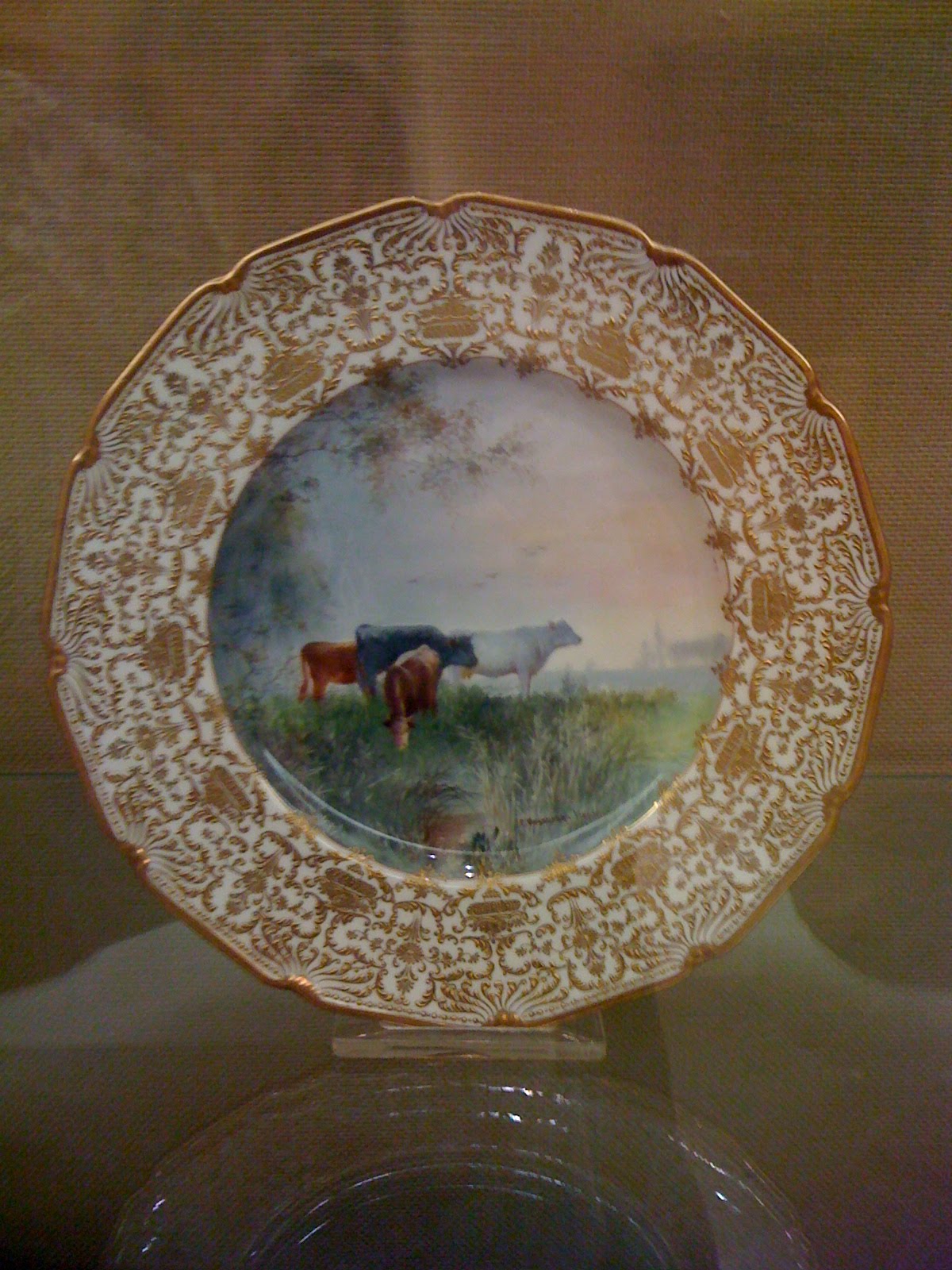
We came to what Steve called "the cow room" which had bronzes, paintings, and sculptures of cows. There are two display cases showcasing these nifty Royal Doulton hand-painted cow plates. Each plate has a different scene:
Showing at the museum until August 1 is a collection of works from artist Alex Dzigurski who painted fabulous seascapes. He was a Serb and was born in 1911. He graduated from the School of Art in Belgrade in 1929. He was drafted into the Yugoslavian army in 1941, was taken prisoner shortly thereafter, escaped, fled to Vienna and worked as a housepainter until the end of the war. He fled to Italy in 1945 and eventually to Pennsylvania in 1949. He eventually settled in California and died in 1995. The paintings at the Norton are from his wife's collection and they're gorgeous. I took this picture, but it doesn't do it justice:
Here are a couple of other paintings I liked, both by Martin Johnson Heade:
I could totally see that one hanging in my house. I love magnolias.
I liked this one, too:
All in all, it was a nice afternoon. We walked the grounds out back afterward and it was hot but still very pretty. It's prettier in the spring when all the azaleas are blooming but it's still very peaceful and nice back there.
If you live around here, put the Norton on your list of places to go. It's a wonderful way to waste away the afternoon. The Norton is known for its collection of Hudson River School paintings. The Bierstadts are gorgeous. There is a Mary Cassatt there that I love but that wasn't out today. There's a room of collectible firearms and a room of dolls (they kind of creep me out but some people are into that sort of thing.) There's also a huge painting by Lloyd Hawthorne of Captain Henry Miller Shreve clearing the great raft from the Red River. And finally, don't miss the tapestries that date from 1541-1546. Most of them depict images from Plutarch's epic, Africa.
Coming up August 17 through the end of the year will be Ansel Adams: The Masterworks.
Below: A brown pelican sculpture on the back grounds. Bonus points if you can tell me what kind of flower that is.
Subscribe to:
Posts (Atom)