Showing posts with label The Kelley Brothers. Show all posts

Thursday, June 6, 2019

D-Day 70th Anniversary: Remembering the Kelley Brothers

6/6/19:  Today is the 75th anniversary of D-Day and I am reposting my tribute to Shreveport's own Kelley brothers.  During the course of this research I was blessed to meet Charlotte, one of the members of the Kelley family and she was a great help in filling out some of the family history.  As this article explains, Bose Kelley was killed in the Normandy invasion on D-Day and is buried in Greenwood cemetery in the veteran's section in Shreveport. If you want to visit his grave it is not hard to find: there are always flowers placed on his grave, and a flag, and he is buried right next to his brother, William.


On this 70th anniversary of D-Day, I'm running a version of one of my columns at DaTechGuy; here in Shreveport, one family lost three sons in less than two years in World War II.  During that war many families across our nation lost more than one son, but as far as I know, the Kelley family is the only family in Shreveport that lost three sons-- one of them in the invasion of Normandy on June 6, 1944.  

Like all of America, Shreveport watched the unfolding events at Pearl Harbor in 1941 with horror.  

In February 1942, William G. Kelley (his friends and family called him “Bob”) felt the call to service and enlisted in the Army Air Corps.  He had graduated from the local high school, attended Louisiana College, and was attending seminary.  He was ordained at the First Baptist Church in Shreveport by Dr. M. E. Dodd.  When he enlisted, Bob was preaching at the Evangeline Mission, a new church in town that he helped build with the assistance of the Queensborough Baptist Church.


Bob Kelley went to officers’ school and became a bombardier; he went with the Eighth Air Force to England.  Lt. Kelley had been overseas only six weeks when his plane crashed near Fontainebleau, France and claimed his life on November 10, 1944.  He was twenty-four years old.

The Evangeline Mission, where Bob was a preacher, was renamed for him as Kelley Memorial Baptist Church.

A second Kelley son, Bose, Jr., died in the D-Day invasion.  Al McIntosh, writing for the Rock County Star Herald, wrote on June 8, 1944, after learning that the expected invasion of France had finally taken place:
“This is no time for any premature rejoicing or cockiness because the coming weeks are going to bring grim news.  This struggle is far from over – it has only started – and if anyone thinks that a gain of ten miles means that the next three hundred are going to go as fast or easy he is only an ostrich.”
He was correct:  the grim news was only beginning.

William Kelley
Bose Kelly, Jr. enlisted in May 1942.  Bose graduated from Fair Park High School in Shreveport.  He was married to Betty Miller and working as a mechanic at Central Motor Company, a car dealership.  Bose volunteered for the Army Airborne, went to jump school and became a paratrooper.  Bose was part of the 507 PIR which became attached to the 82nd Airborne in 1943. The 507 PIR was activated at Fort Benning, Georgia on July 20, 1942 and trained there and in Alliance, Nebraska.  In 1943, the 507th PIR shipped out to Northern Ireland, then England, and it was in Nottingham where they prepared for the coming Allied invasion of France.  They studied sand tables, drop zones, and were given Hershey’s chocolates and a carton of cigarettes.

Bose was on a C-47, number 13 in his stick, as the plane lumbered through the fog banks toward Drop Zone T, near the west bank of the Merderet River.  Because of the fog and the incoming German flak, the C-47s flew faster and higher than anticipated which caused almost all of the paratroopers to miss the drop zone.  They were scattered over a 15 mile area.  The 507th was the last regiment to jump and by the time Bose Kelley’s C-47 was over the Cotentin peninsula the entire area was stirred up with flak coming from every direction. There were sixteen men in Bose Kelley’s stick and at least eight of them were killed that night.  The Germans had flooded the valley as a defensive tactic and some paratroopers, weighted down by equipment and unable to swim, drowned.  Bose Kelley was killed by a direct hit from an artillery shell.

Major General Paul F. Smith wrote in his Foreword to Dominique Francois’s history of the 507th,
“This regiment unquestionably received the worst drop of the six US parachute regiments dropped that night.”
Howard Huebner, who was number 3 in Bose’s stick, survived that drop.  He wrote:
I am a Paratrooper! I was 21 yrs old when we jumped into Normandy. 
We knew the area where we were supposed to land, because we had studied it on sand tables, and then had to draw it on paper by memory, but that all faded as our regiment was the last to jump, and things had changed on the ground. Most of us missed our drop zone by miles.  As we were over our drop zone there was a downed burning plane. Later I found out it was one of ours. The flack was hitting our plane and everything from the ground coming our way looked like the Fourth of July. 
When I hit the ground in Normandy, I looked at my watch.  It was 2:32 AM, June 6, 1944. I cut myself out of my chute, and the first thing I heard was shooting and some Germans hollering in German, "mucksnell toot sweet Americanos". 
We the 507th, was supposed to land fifteen miles inland, but I landed three or four miles from Utah Beach by the little town of Pouppeville. I wound up about 1000 yards from a French farm house that the Germans were using for a barracks, and about 200 feet from a river, an area that the Germans had flooded. If I would have landed in the water, I may not be here today as I can’t swim. A lot of paratroopers drowned because of the flooded area.
Local writer Gary Hines spoke to Bose’s widow, Betty, for an article he wrote for the August 2000 issue of SB Magazine.  She told him, “He was going to win the war and come back home.”  Betty was married at 18 and a widow at 20.  She told Mr. Hines “We were both young enough to feel that he was coming home.  He wasn’t going to be one of the ones who was lost.”

A third Kelley son, Edgar Rew, was drafted into the Army in 1943.  He was sent to Camp McCain in Mississippi where he died five weeks later from an outbreak of spinal meningitis.  He never made it out of basic training.  He was 27 years old; he left behind a wife of five years.

The remaining Kelley brother was Jack.  Jack Richard Kelley was serving in the medical corps in Washington at Fort Lewis.  His father, Bose Kelley, Sr., wrote to U.S. Representative Overton Brooks and pleaded with him to prevent his oldest son from going overseas.   It is reminiscent of the scene in Saving Private Ryan where General Marshall reads the Bixby letter to his officers.  In this case, in a letter dated December 8, 1944, Mr. Kelley received word that his son Jack would remain stateside for the duration of the war.  Jack Kelley died in 1998.
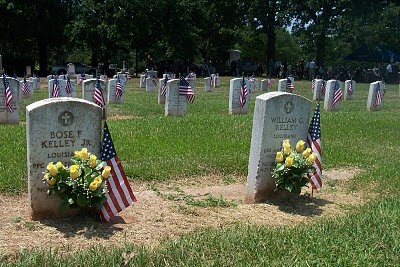
The bodies of Bose Kelley, Jr. and his brother William (Bob) were buried in separate military funerals in France but were returned to the United States in September 1948.  Bose and his brother now rest side by side in the veterans section of Greenwood Cemetery in Shreveport.  Their brother, Edgar Rew Kelley, is in a civilian cemetery across town, the Jewella Cemetery on Greenwood Road.  Their father, who pleaded for his fourth son to be spared, died just one month after Bose and William’s bodies were buried in Greenwood Cemetery.  It’s as if he was just waiting for them to come home.

For sixty-five years their sister, Ruby, tended the graves of her brothers.  There has never been a time that I visited the graves that there was not a crisp American flag flying over each and flowers.  Ruby died last year and the graves are now tended by Ruby's daughter.  I visited the graves of Bose and William last week and sure enough, there were two new flags and flowers steadfastly in place.

As we observe this 70th anniversary of D-Day, we remember the sacrifices of young men like the Kelleys all across the country. Their name belongs alongside the Sullivan brothers, the Borgstrum brothers, the Niland brothers, and the Wright brothers.  It is their heroism and their sacrifice, along with that of so many others, that we remember and honor.

For further reading:


Monday, June 6, 2016

D-Day 2016: Remembering the Kelley Brothers


On this anniversary of D-Day, I'm running a version of one of my columns at DaTechGuy; here in Shreveport, one family lost three sons in less than two years in World War II.  During that war many families across our nation lost more than one son, but as far as I know, the Kelley family is the only family in Shreveport that lost three sons-- one of them in the invasion of Normandy on June 6, 1944.  

Like all of America, Shreveport watched the unfolding events at Pearl Harbor in 1941 with horror.  

In February 1942, William G. Kelley (his friends and family called him “Bob”) felt the call to service and enlisted in the Army Air Corps.  He had graduated from the local high school, attended Louisiana College, and was attending seminary.  He was ordained at the First Baptist Church in Shreveport by Dr. M. E. Dodd.  When he enlisted, Bob was preaching at the Evangeline Mission, a new church in town that he helped build with the assistance of the Queensborough Baptist Church.

William
William "Bob" Kelley
Bob Kelley went to officers’ school and became a bombardier; he went with the Eighth Air Force to England.  Lt. Kelley had been overseas only six weeks when his plane crashed near Fontainebleau, France and claimed his life on November 10, 1944.  He was twenty-four years old.

The Evangeline Mission, where Bob was a preacher, was renamed for him as Kelley Memorial Baptist Church.

A second Kelley son, Bose, Jr., died in the D-Day invasion.  Al McIntosh, writing for the Rock County Star Herald, wrote on June 8, 1944, after learning that the expected invasion of France had finally taken place:
“This is no time for any premature rejoicing or cockiness because the coming weeks are going to bring grim news.  This struggle is far from over – it has only started – and if anyone thinks that a gain of ten miles means that the next three hundred are going to go as fast or easy he is only an ostrich.”
He was correct:  the grim news was only beginning.

bose
Bose F. Kelley, Jr.
Bose Kelly, Jr. enlisted in May 1942.  Bose graduated from Fair Park High School in Shreveport.  He was married to Betty Miller and working as a mechanic at Central Motor Company, a car dealership.  Bose volunteered for the Army Airborne, went to jump school and became a paratrooper.  Bose was part of the 507 PIR which became attached to the 82nd Airborne in 1943. The 507 PIR was activated at Fort Benning, Georgia on July 20, 1942 and trained there and in Alliance, Nebraska.  In 1943, the 507th PIR shipped out to Northern Ireland, then England, and it was in Nottingham where they prepared for the coming Allied invasion of France.  They studied sand tables, drop zones, and were given Hershey’s chocolates and a carton of cigarettes.

Bose was on a C-47, number 13 in his stick, as the plane lumbered through the fog banks toward Drop Zone T, near the west bank of the Merderet River.  Because of the fog and the incoming German flak, the C-47s flew faster and higher than anticipated which caused almost all of the paratroopers to miss the drop zone.  They were scattered over a 15 mile area.  The 507th was the last regiment to jump and by the time Bose Kelley’s C-47 was over the Cotentin peninsula the entire area was stirred up with flak coming from every direction. There were sixteen men in Bose Kelley’s stick and at least eight of them were killed that night.  The Germans had flooded the valley as a defensive tactic and some paratroopers, weighted down by equipment and unable to swim, drowned.  Bose Kelley was killed by a direct hit from an artillery shell.

Major General Paul F. Smith wrote in his Foreword to Dominique Francois’s history of the 507th,
“This regiment unquestionably received the worst drop of the six US parachute regiments dropped that night.”
Howard Huebner, who was number 3 in Bose’s stick, survived that drop.  He wrote:
I am a Paratrooper! I was 21 yrs old when we jumped into Normandy. 
We knew the area where we were supposed to land, because we had studied it on sand tables, and then had to draw it on paper by memory, but that all faded as our regiment was the last to jump, and things had changed on the ground. Most of us missed our drop zone by miles.  As we were over our drop zone there was a downed burning plane. Later I found out it was one of ours. The flack was hitting our plane and everything from the ground coming our way looked like the Fourth of July. 
When I hit the ground in Normandy, I looked at my watch.  It was 2:32 AM, June 6, 1944. I cut myself out of my chute, and the first thing I heard was shooting and some Germans hollering in German, "mucksnell toot sweet Americanos". 
We the 507th, was supposed to land fifteen miles inland, but I landed three or four miles from Utah Beach by the little town of Pouppeville. I wound up about 1000 yards from a French farm house that the Germans were using for a barracks, and about 200 feet from a river, an area that the Germans had flooded. If I would have landed in the water, I may not be here today as I can’t swim. A lot of paratroopers drowned because of the flooded area.
Local writer Gary Hines spoke to Bose’s widow, Betty, for an article he wrote for the August 2000 issue of SB Magazine.  She told him, “He was going to win the war and come back home.”  Betty was married at 18 and a widow at 20.  She told Mr. Hines “We were both young enough to feel that he was coming home.  He wasn’t going to be one of the ones who was lost.”

edgarrew
Edgar Rew Kelley
A third Kelley son, Edgar Rew, was drafted into the Army in 1943.  He was sent to Camp McCain in Mississippi where he died five weeks later from an outbreak of spinal meningitis.  He never made it out of basic training.  He was 27 years old; he left behind a wife of five years.

The remaining Kelley brother was Jack.  Jack Richard Kelley was serving in the medical corps in Washington at Fort Lewis.  His father, Bose Kelley, Sr., wrote to U.S. Representative Overton Brooks and pleaded with him to prevent his oldest son from going overseas.   It is reminiscent of the scene in Saving Private Ryan where General Marshall reads the Bixby letter to his officers.  In this case, in a letter dated December 8, 1944, Mr. Kelley received word that his son Jack would remain stateside for the duration of the war.  Jack Kelley died in 1998.

kelleys
Sunday, May 18, 2014
The bodies of Bose Kelley, Jr. and his brother William (Bob) were buried in separate military funerals in France but were returned to the United States in September 1948.  Bose and his brother now rest side by side in the veterans section of Greenwood Cemetery in Shreveport.  Their brother, Edgar Rew Kelley, is in a civilian cemetery across town, the Jewella Cemetery on Greenwood Road.  Their father, who pleaded for his fourth son to be spared, died just one month after Bose and William’s bodies were buried in Greenwood Cemetery.  It’s as if he was just waiting for them to come home.

For sixty-five years their sister, Ruby, tended the graves of her brothers.  There has never been a time that I visited the graves that there was not a crisp American flag flying over each and flowers.  Ruby died last year and the graves are now tended by Ruby's daughter.  I visited the graves of Bose and William last week and sure enough, there were two new flags and flowers steadfastly in place.

As we observe this 70th anniversary of D-Day, we remember the sacrifices of young men like the Kelleys all across the country. Their name belongs alongside the Sullivan brothers, the Borgstrum brothers, the Niland brothers, and the Wright brothers.  It is their heroism and their sacrifice, along with that of so many others, that we remember and honor.

For further reading:

Saturday, May 30, 2015

Take a Trip to Two 2015 Memorial Day Ceremonies in Shreveport

We observe Memorial Day twice around here - one on the federally designated holiday and again on true Memorial Day, May 30.


The federal holiday fell on May 25 this year and we went to the ceremony at the Northwest Louisiana Veterans Cemetery near Keithville.

The ceremony was very well attended with many dignitaries present; this year a new monument was unveiled to honor the sacrifice of veterans.  The Battlefield Cross monument dedicated at the ceremony was approved by Arlington National Cemetery and depicts a family member kneeling at the foot of a Battle Cross made of the boots, weapon, helmet, and dog tags of a fallen soldier.


There were speeches by dignitaries


and placing of wreathes.


The Young Marines did an excellent job.


The ceremony closed with a salute.


Today, May 30, was the Memorial Day Service at Greenwood Cemetery at the corner of Centenary and Stoner in Shreveport.  This service is sponsored by the Disabled American Veterans, Chapter 30.


Greenwood Cemetery is among Shreveport's oldest and has a large veterans section.  This is where two of the Kelley brothers are buried.


The graves are always decorated.

This ceremony is dear to us and I'm always a little sad that it isn't better attended by the general public.


The veterans organizations and the veterans are there every year, though!


We see lots of old friends there.  Here is Steve and his buddy John Long:


John is with the Sons of the Confederacy:


There was a lovely rendition of the National Anthem by Parkway High School AFJROTC:


The speaker today was Lt. Bill Davis who reminded us to always remember the fallen and their sacrifice.  He spoke eloquently of Old Glory and the pride of America.

Then came the wreaths:


The Parkway AFJROTC served as escorts:


Steve placed a wreath for the 40 & 8 Voiture 137.


Our friend Ron Chatelain is always present each year to present:


The Sons of the American Revolution:


The Knights Templar of USA:


The Parkway AFJROTC held a flag folding ceremony...


...and the event closed with a gun volley by the Sons of the Confederacy:


With the playing of TAPS, it was over.

The Parkway AFJROTC always does a lovely job at this event and God bless John Andrew Prime of The Shreveport Times who is the epitome of the old school newspaperman and I mean that in the best way. With notebook in hand and whatever it takes, he is there for vets every single time.


If you missed it this year, put this on your calendar for next year.

Take time today to remember.

The SIGIS Take a Trip Series:
Take a Trip to the 2012 Defenders of Liberty Air Show at BAFB
Take a Springtime Trip to Second Hand Rose Antiques in Minden, LA
Take a Trip to Logansport, Louisiana
Take a Trip to the Lock and Dam on Red River
Take a Trip to the 2012 Barkus and Meoux Parade
Take a Christmas Shopping Trip to Second Hand Rose in Minden
Take a Trip to the Fourth Annual Barksdale AFB Oktoberfest 
Take a Trip to Grand Cane's Fifth Annual Pioneer Trade Day
Take a Trip to the 2011 Highland Jazz & Blues Festival
Take an Autumn Trip to Jefferson, Texas
Take a Fall Trip to Second Hand Rose Antiques in Minden
Take a Trip to the 8th Air Force Museum at Barksdale Air Force Base
Take a Summertime Trip to Grand Cane
Take a Trip to Desoto Parish
Take a Summer Trip to Second Hand Rose Antiques in Minden
Take a Trip to Natchitoches and Melrose Plantation 
Take a Trip to Ed Lester Farms and a Random Antique Stop
Take a Trip to the Norton Art Gallery and the Masters of Cuban Art Exhibit
Take a Trip to Natchitoches to See the Christmas Lights
Take a Trip to the Third Annual BAFB Oktoberfest 
Take a Trip to Natchitoches and Oakland Plantation